

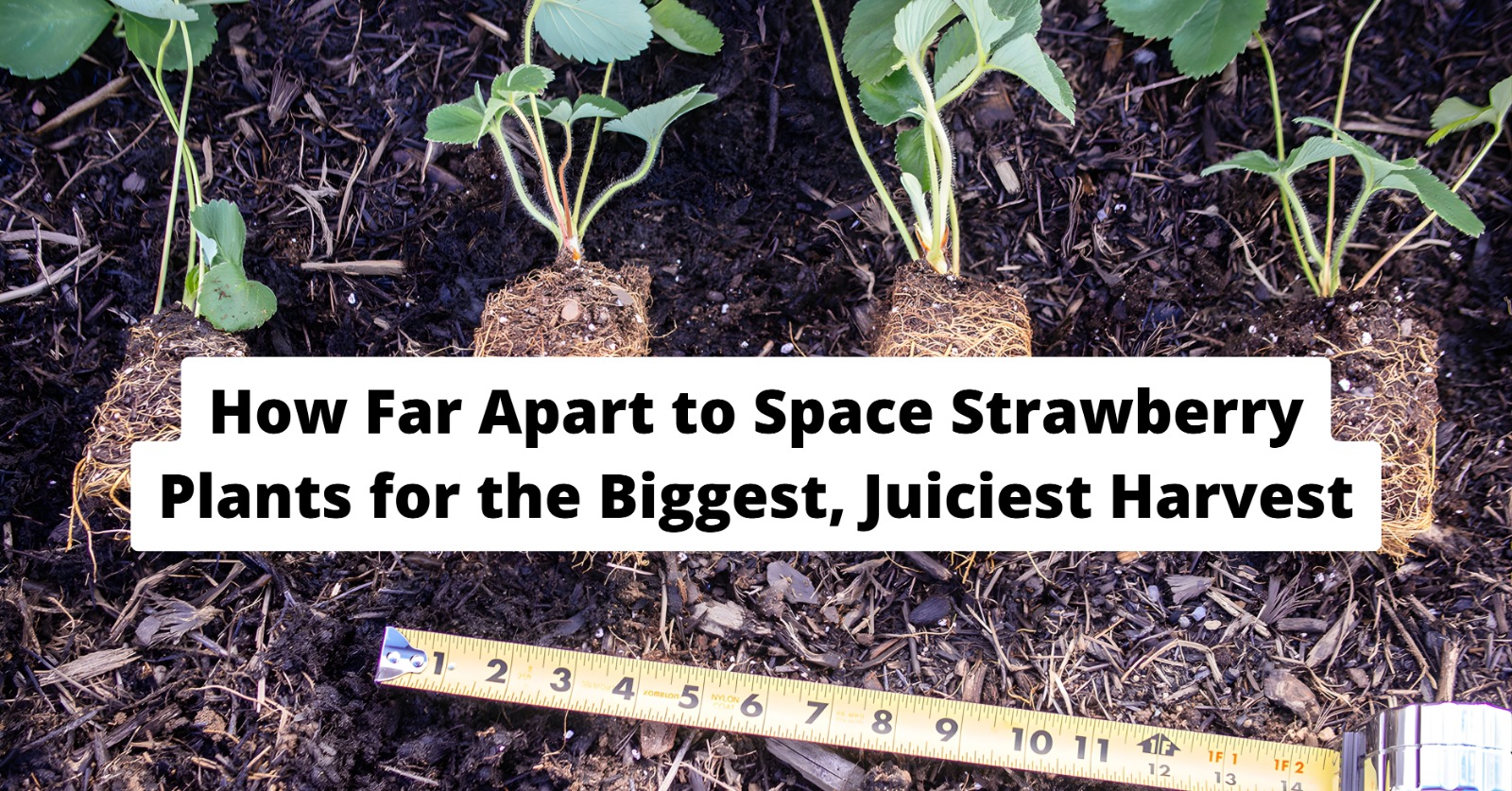
How far apart you plant your strawberries doesn’t seem hugely important, but studies on farms have repeatedly demonstrated that it’s one of the biggest things influencing how big your berries get, how much fruit you harvest, and how well your plants do. If they’re too close together, the plants will battle for sun, water and food, making for smaller berries and a damp, packed environment where fungus is likely to flourish. However, leaving too much room between plants means you’re losing good area in your garden that could have been growing more strawberries. Exactly the right spacing depends on what variety of strawberry you’re growing, and how you’ve decided to plant them.
Spacing for the Matted Row System
The matted row is the oldest and most common way to grow June-bearing strawberries. Mother plants are put in the ground 18 to 24 inches from each other, and the rows themselves are three or four feet apart. Throughout the year, the mother plants grow long, spreading stems (called runners) and new plants develop at the end of each one. These new plants root right where they are, and eventually the whole row fills with a thick, 18 inch wide tangle of plants. The spaces between the rows are kept open to allow easy picking and for air to move around. You don’t have to do a lot to this system and you get a huge amount of strawberries overall, although each berry might be a little smaller than if you planted them in a more carefully managed way.

Spacing for the Hill System
With the hill or mound method, getting huge berries is more important than having a lot of stems. Plants are spaced 12 to 15 inches apart in every direction, and within a raised bed, you’ll often find them in two or even three lines, shifted so they aren’t directly in front of each other. All those stems (runners) are taken off as they start to grow. This makes the plant put all its strength into the main plant itself and into making fruit, not into making more plants. You’ll get exceptionally large berries using this, and it’s especially good for raised beds, pots, or if you don’t have a lot of room. But be warned, it’s more work than a matted row system because you have to keep taking off those runners all during the growing months.
Spacing for Everbearing and Day-Neutral Varietie
Unlike June-bearing strawberries that give you a big crop all at once, everbearing and day-neutral strawberries keep making fruit all season long. These types do really well when grown in a “hill” system with plants 8 to 12 inches apart. They don’t make as many runners as June-bearing types, and are actually quite happy with being closer together and having those runners taken off. Because they’re always making berries, the energy they’d have used for runners instead goes straight into growing the berries themselves. This often gives you a regular harvest from late spring and all the way into early fall.
Spacing in Containers and Raised Beds
However you’re growing your strawberries – in pots, window boxes, or little raised beds – give each plant between eight and twelve inches of space; this applies to all different kinds of strawberries. If you’re using hanging baskets or strawberry towers, you can get away with plants being only six to eight inches apart. Because these grow downwards and get air all around them, they don’t mind being closer together. Strawberries in containers do best when you cut most of the long stems (runners) off to keep the main plant strong. But, letting one or two of those runners hang down over the side of a hanging basket looks lovely as they trail.

Key Takeaway
How far apart you plant your strawberries varies depending on what kind of strawberry you have and how you’re growing them. If you have June-bearing plants in a matted row, give them 18 to 24 inches of space between each plant and 3 to 4 feet between each row. For the hill system, where you take off all the runners to encourage extra large berries, plants should be 12 to 15 inches apart. And everbearing and strawberries grown in containers do best with 8 to 12 inches between each one. Getting the spacing right is important because it allows air to flow around the plants, helps to prevent diseases, and leads to much bigger and better fruit.
Leave a Reply