

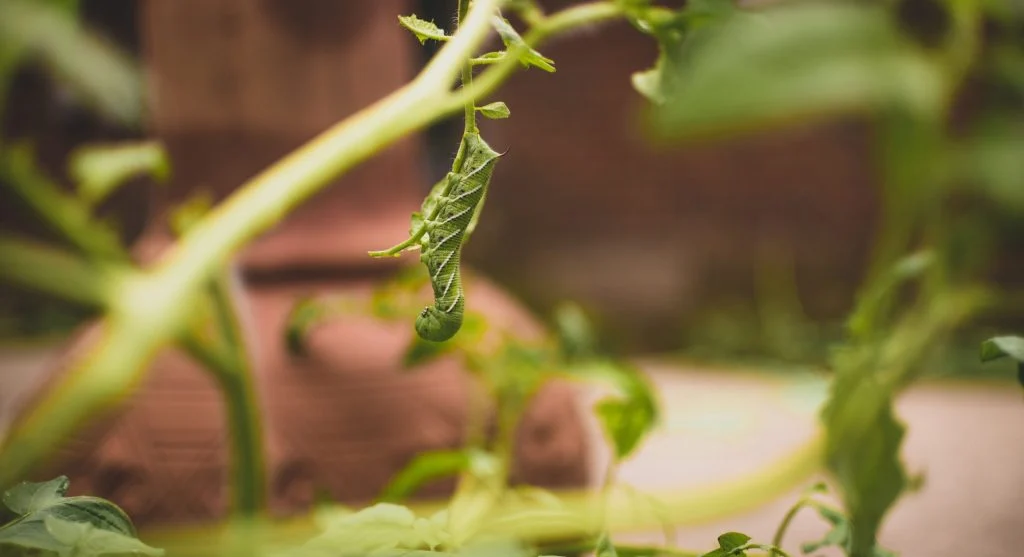
The tomato hornworm (Manduca quinquemaculata) is one of the largest and hungriest caterpillars found in North American gardens. A single hornworm can reach up to four inches long and strip the foliage from an entire tomato plant in just a few days. Even with their large size, hornworms can be surprisingly hard to see because their bright green bodies blend almost perfectly with tomato leaves. Many gardeners do not realize they have a problem until they find large sections of a tomato plant stripped bare overnight. Entomologists point out that hornworm damage often looks more alarming than it really is. A strong, healthy tomato plant can handle a fair amount of leaf loss and recover well, especially when the caterpillars are found and removed before they eat more than 30 percent of the foliage.
Finding Hornworms: Follow the Frass
The easiest way to find hornworms on a tomato plant is to look for their droppings, known as frass, instead of searching for the caterpillars first. Hornworm frass is easy to recognize. It appears as dark green or black pellets, roughly the size of peppercorns, and can be found on leaves or on the ground beneath the plant. Fresh frass on a leaf usually means a hornworm is feeding somewhere directly above that spot. By following the trail upward through the plant canopy, gardeners can usually find the caterpillar feeding on fresh growth near the branch tips. A careful check in the early morning or late evening, when hornworms are feeding more actively and are a little easier to notice, can stop an infestation before serious damage happens.
Hand-Picking: Simple and Completely Effective
Hand-picking is the most dependable way to control hornworms in home gardens. These caterpillars do not bite, sting, or release any harmful substances, so they can be removed by hand. Gardeners can wear gloves if they prefer, then drop the hornworms into a bucket of soapy water, where they die within minutes. In most home gardens, hornworm numbers are usually low. Even three to five caterpillars on one plant is considered a heavy infestation. Because of that, hand-picking is practical and often only needs to be done two or three times in a season. Checking plants daily during peak hornworm season, usually July and August in most regions, helps catch new caterpillars before they do much damage.
Leave the Parasitized Ones Alone
Sometimes gardeners find a hornworm covered in small white cocoons that look like grains of rice sticking out of its body. These are the pupae of braconid wasps (Cotesia congregatus), a parasitic wasp that lays eggs inside the living hornworm. The larvae feed inside the caterpillar, then emerge and pupate on its outer surface. A hornworm with these white cocoons is already dying and will not survive long enough to cause much more damage. More importantly, leaving it on the plant gives the braconid wasps time to finish their life cycle and emerge as adults. Those adult wasps will go on to parasitize future hornworms. Removing or killing a parasitized hornworm also destroys the beneficial wasps, which are one of the garden’s best natural defenses against future hornworm generations.
Biological Control: Bt for Severe Infestations
For gardens dealing with unusually heavy hornworm pressure, especially when hand-picking is not enough, Bacillus thuringiensis, or Bt, offers a targeted biological control option. Bt is a naturally occurring soil bacterium that produces a protein toxic to caterpillars when they eat it. When sprayed on tomato foliage, it kills hornworms and other caterpillars that feed on treated leaves within 24 to 48 hours. It does not affect adult insects, bees, humans, pets, or other non-target organisms. Bt needs to be reapplied after rain and every five to seven days during active hornworm season because sunlight breaks down the active protein on the leaf surface.
Prevention Through Garden Hygiene
Hornworm pupae spend the winter in the soil, usually three to six inches below the surface. Tilling or turning the top six inches of soil in fall and again in spring exposes the pupae to freezing temperatures, drying conditions, and hungry birds, which can reduce the number of adult moths that emerge the next summer. Crop rotation also helps lower hornworm pressure. Moving tomatoes and other nightshade crops to different beds each year makes it harder for newly emerged adult moths to find host plants nearby. When tomatoes are planted in a new location, the moths may not locate them as easily.