
Tomato pruning is one of the most argued-about subjects in home vegetable gardening. Some gardeners prune heavily, removing nearly every side shoot and lower branch. Others do not prune at all, letting their tomato plants turn into thick, sprawling growth. Both methods can cause problems. Too much pruning reduces the plant’s leaf coverage and leaves fruit vulnerable to sunscald.
No pruning, on the other hand, creates a dense canopy that holds moisture and encourages fungal diseases, one of the main reasons tomato crops fail. The best approach, recommended by horticultural researchers and experienced growers, sits somewhere in the middle: targeted pruning that removes specific growth while keeping the plant productive.
The Critical First Distinction: Determinate vs. Indeterminate
Before pruning any tomato plant, it is important to know whether the variety is determinate or indeterminate. The right pruning method depends entirely on this difference. Determinate tomatoes, often called bush types, include varieties such as Roma, Celebrity, and Rutgers. These plants grow to a set height, produce most of their fruit within a shorter window, and then begin to decline. They need very little pruning, usually only the removal of the lowest branches to improve air circulation. Taking off side shoots from determinate plants can reduce the overall harvest because these plants have a limited number of fruiting branches.
Indeterminate tomatoes, including vining varieties such as Brandywine, Cherokee Purple, Sun Gold, and most cherry tomatoes, keep growing throughout the season. They continue producing new stems, flowers, and fruit until frost ends the plant’s growth. These tomatoes benefit most from strategic pruning because it helps direct energy into fewer, stronger fruit clusters while keeping the canopy open enough to resist disease.
Credit: Doğan Alpaslan Demir / Pexels
What to Remove: Suckers and Lower Foliage
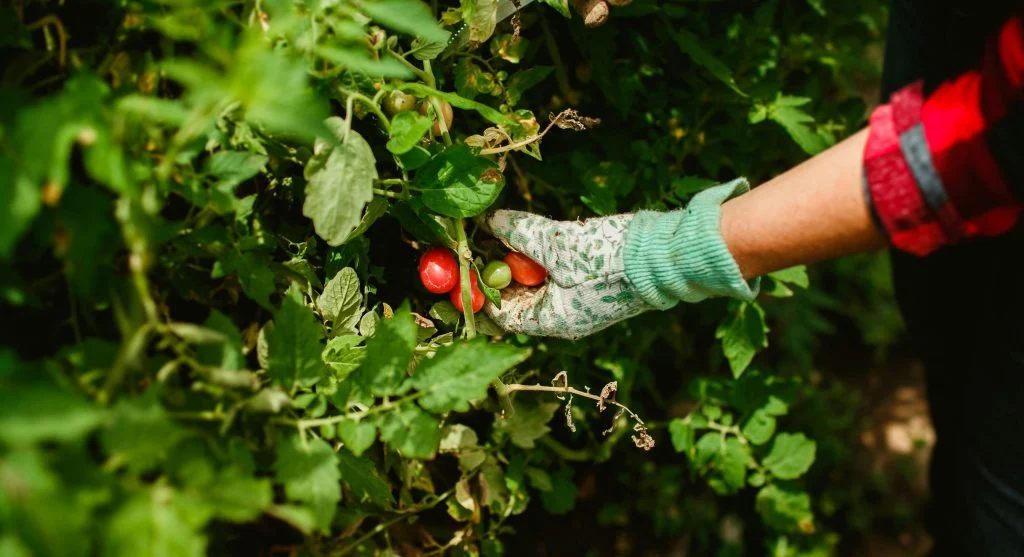
On indeterminate tomatoes, the main pruning targets are suckers. These are the small shoots that grow from the junction, or axil, where the main stem meets a side branch. If left alone, each sucker can become a full secondary stem with its own flowers, fruit, and additional suckers. This growth can produce tomatoes, but the plant’s energy gets divided among too many growing points, often resulting in smaller yields per fruit cluster. Removing suckers below the first flower cluster, and thinning some suckers above it, helps focus energy into fewer clusters, leading to larger tomatoes and earlier ripening.
The lowest 12 to 18 inches of foliage should also be removed from the main stem, but for a different reason: disease prevention. Fungal spores in the soil can splash onto the lower leaves during rain or watering. The moist conditions close to the ground also encourage early blight, Septoria leaf spot, and other common tomato diseases to spread. Removing those lower branches creates space between the soil and the remaining foliage, which greatly reduces the chance of disease transmission.
When and How to Prune
Suckers are easiest to remove when they are still small, about two to four inches long. At that stage, they can usually be pinched off cleanly with your fingers. Larger suckers should be removed with clean, sharp pruning shears to avoid tearing the stem. Prune during dry weather whenever possible, since this lowers the risk of pathogens entering through fresh cuts.
Checking for suckers once a week during the active growing season keeps the plant easier to manage and prevents the need for heavy pruning all at once. Removing too much foliage in one session can stress the plant. As a rule, taking off more than one-third of the plant’s leaves at one time can also expose previously shaded fruit to sunscald.
Credit: Yunus Kılıç / Pexels